
Published online: December 2025
Synthesis by: Dr Yolanda van Heezik, Otago University (yolanda.vanheezik @ otago.ac.nz)
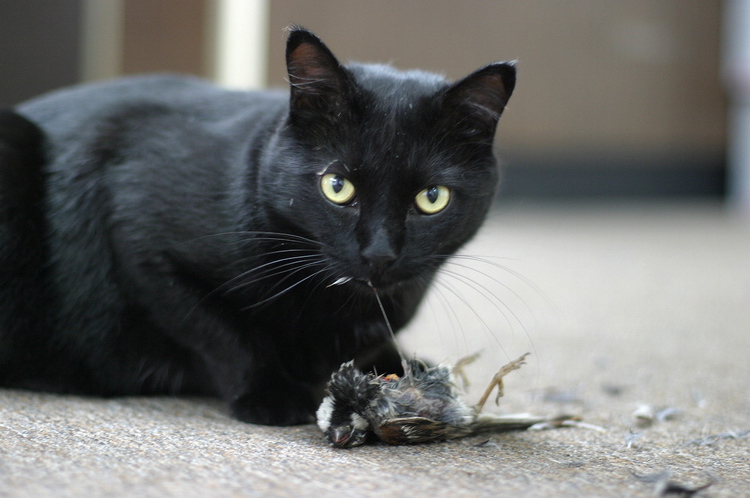
Back in 2013 Gareth Morgan drew the New Zealand public’s attention to the negative impact that roaming cats have on our native biodiversity with his campaign “Cats to Go”. I don’t know whether he anticipated the degree of vilification and misinterpretation of his message that ensued, but he had the courage to initiate badly needed discourse and he must have felt some degree of satisfaction when the government finally announced, 12 years later, that feral cats would be added to the official Predator-Free 2050 hitlist. Of course, feral cat control has been taking place for many decades, but the new status of feral cats allows better national coordination of feral cat control, provides pathways for funding to predator-free groups targeting feral cats, and supports research on effective management strategies.
From my perspective, the announcement is welcome tangible evidence of a shift in public attitude towards management of cats, especially after the failure of two petitions arguing for national-level legislation on domestic/owned cat management. We argued in Lepczyk et al. (2022) that political and legislative recognition of free-roaming cats as an invasive species is a critical first step for effective science-driven management of cats. Policies or arguments that are politically acceptable to the mainstream at any one time are referred to as the Overton Window, which can shift in response to the slow evolution of societal values and norms. Regarding cat management, we have campaigns from groups like the Morgan Foundation, Forest & Bird, the SPCA and Predator Free NZ Trust, often working together with the National Cat Management Strategy Group, to thank for shifting The Overton Window in New Zealand. However, the addition of feral cats (i.e., unowned and living independently of humans for survival) to the PF-50 list is only a step towards the ultimate goal – no more free-roaming cats.
In a Hot Topic I wrote back in 2019, I argued for a greater focus on how we should manage stray (unowned but still relying partly on humans for food and shelter) and free-roaming owned cats. Both are abundant predators across urban areas, significantly compromising the ability of urban habitats to support many native species that might otherwise thrive. Moreover, un-owned cats (strays and dumped cats) constantly reinforce feral cat populations. Effective feral cat control can only occur if these other problems are addressed, and this requires a multi-faceted and coordinated evidence-led strategy that also acknowledges the important role that owned cats play as companion animals. But how long is it going to take before the Overton Window encompasses legislation regulating owned cats?
The closest that proponents advocating for national legislation enabling management of owned cats have got to date was in 2021 when parliament’s Environment Committee considered the petition by Erica Rowland which requested to mandate the registration and desexing of cats. Despite coordinated support from all the major agencies, and the recommendation from the Environment Committee in 2023 that the government should legislate for a nation-wide cat management framework that already exists for dogs, the government declined to progress this work. While this result was discouraging, I’m optimistic that the recent high-profile recognition of feral cats as belonging to the suite of invasive, destructive predators in New Zealand, should reinforce attitudes that cats and native species can’t co-exist, and should help eventually to shift the window to include political and legislative support for the holy grail of cat management – indoor cats.
Lepczyk, C. A., Duffy, D. C., Bird, D. M., Calver, M., Cherkassky, D., Cherkassky, L., ... & van Heezik, Y. (2022). A science-based policy for managing free-roaming cats. Biological invasions, 24(12), 3693-3701. https://doi.org/10.1007/s10530-022-02888-2